
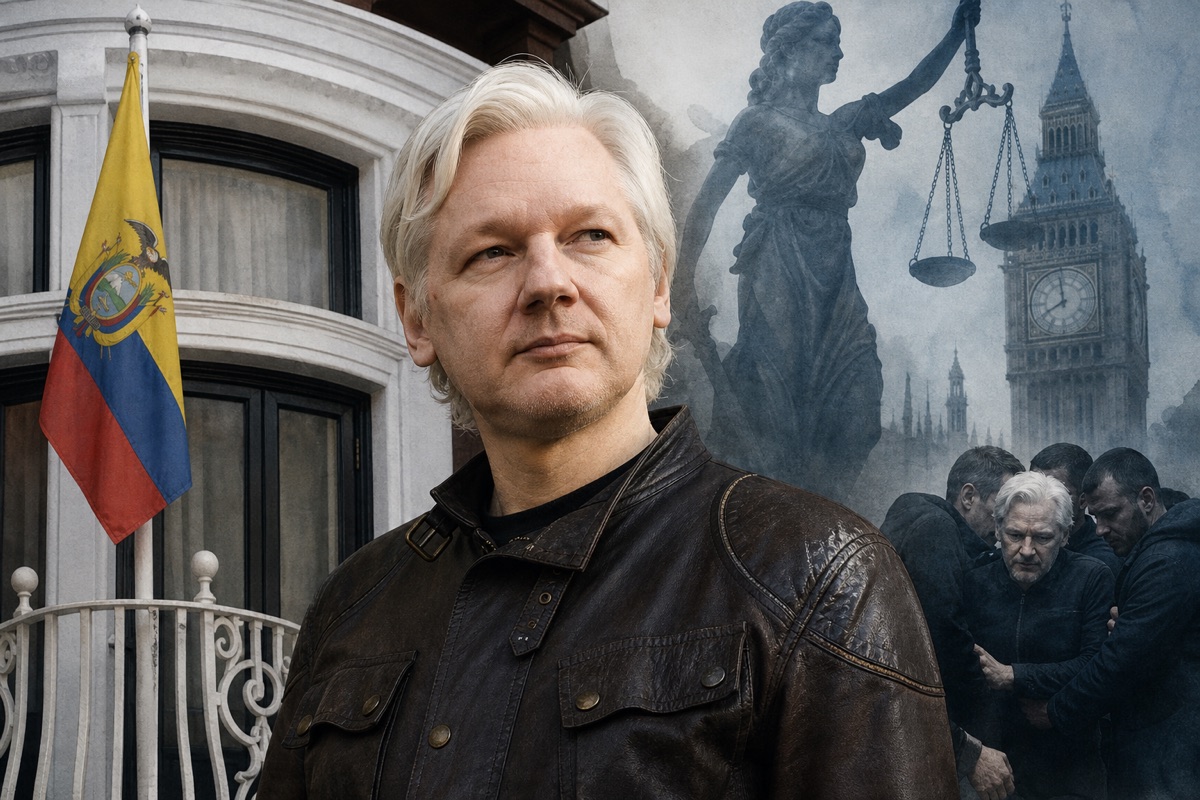
It wouldn’t be a stretch anymore to say Julian Assange is a celebrity – albeit a strange and reclusive celebrity (think Michael Jackson circa 2006). Like famous luminaries Ian Thorpe and Ellen Page, Assange is also apparently prepared to come out… of the Ecuadorian Embassy. It is here that he has spent the last two years, fighting extradition to Sweden where he is wanted for questioning over sexual incidents that allegedly occurred towards two women in 2010. The press conference, called by Assange on August the 18th, incited a particularly intense interest by the mass media, ostensibly because of his conviction: “I am leaving the embassy… soon.” How ominous. How mysterious. Yes, the press conference was quintessential Assange.
It can be hard to recall exactly how Assange has found himself in a converted office, in an island in a sea of hostility, giving speeches from his balcony like an exiled king. Two years is, after all, an extended period of time (Australia has had three Prime Ministers in that length). But Assange has proven to be a tougher nut than Bradley Manning or Edward Snowden: he carries an air of detachment, of self-belief, as though he is somehow above the media circus going on beneath, and that he considers an office of the Ecuadorian Embassy ample accommodation for his life’s work.
His presence in the Embassy is a convoluted enough tale as it is. Assange is currently a person of extreme interest for no less than three nations: Sweden, the United Kingdom, and the USA. Sweden would like to question Assange over alleged sexual misconduct occurring in 2010. They’ve filed necessary warrants for the detention of Assange, but have stopped short of formally charging him. Living in the UK at the time, he was also notified of an application by Swedish authorities in a United Kingdom Court to extradite him. This extradition warrant was upheld in late February 2011, a subsequent appeal was dismissed in late May, 2012. On conditional bail from British authorities, it was a fortnight after this decision that Assange formally sought political asylum in the Ecuadorian Embassy, which was granted on August 16, 2012. The UK authorities have police stationed around the Embassy at all times to intercept Assange if and when he leaves (which, it may also be mentioned, has now cost six and a half million pounds). So where does America get involved?
Well.
WikiLeaks initially came under American legal attention with the release of material leaked by Chelsea (formerly Brad) Manning (who, by the way, is serving 35 years in federal prison for his role). Between 2010 up to as recently as May 2014, statements have been made and documents have been released (or leaked – guess by who?) to the effect that Assange was still under active and ongoing investigation. The complicating factor here is that Sweden have given no assurances that once they’ve completed their investigation of Assange, they won’t just hand him over to America – an understandably concerning thought judging by Chelsea Manning’s example.
With such legal pressure, why on Earth would Assange think about coming out now? Well, what we do know… well actually, no, it’s not really clear what we do know at this point. He seems to implicitly confirm that he is not leaving for health related reasons, as speculated by the Murdoch media. But there is no timeline, other than “soon.” Assange seems to have placed a lot of weight in a raft of legal reforms taking place in the United Kingdom which, in part, covers situations he finds himself in. The Ecuadorian Foreign Minister confirmed diplomats would be meeting with the British government to discuss Assange’s status, but whether that pertains to his absolute freedom or to safe passage back to Ecuador, we don’t know. In fact we seem to know less than we knew before he called the press conference.
Yet another piece added to the puzzle, and yet we still find ourselves far from ascertaining Assange’s motives, methods, or even the man himself. One suspects that Assange is deeply afraid of the weight of the American justice system, and their potential to strongarm Sweden into giving him to them. After all, it would be ironic if Assange, lauded by libertarians the world over for shedding light on a raft of questionable government activities, refused to face court in Sweden because of the truth of what happened with those two Swedish girls back in 2010. If convicted, he would probably serve less time than he already has in the Ecuadorian Embassy.
By Alex Treacy
Tagged: 2014, Bradley Manning, Equadorian Embassy, Julian Assange, WikiLeaks